


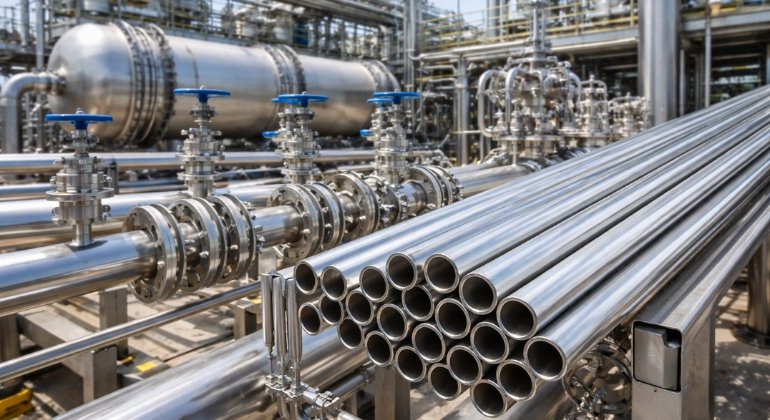
Engineering, Procurement, and Construction (EPC) contractors operating in the United Arab Emirates and Saudi Arabia work under some of the most demanding process conditions globally. Desalination plants, oil refineries, gas processing facilities, and petrochemical complexes in these regions are exposed to high salinity, elevated temperatures, aggressive chemicals, and continuous operating cycles. Under such conditions, material selection is driven by long-term reliability, corrosion resistance, and strict compliance with international standards.
ASTM A269 TP316 seamless tubes have become a preferred specification for EPC projects across the Middle East due to their proven performance in critical fluid and gas handling systems. This article explains why TP316 seamless tubing is repeatedly specified, how it compares with alternatives, and where it is most effectively used in real-world EPC applications.
Understanding ASTM A269 and TP316 Grade Requirements
ASTM A269 is a standard specification covering seamless and welded austenitic stainless steel tubing for general service applications where corrosion resistance and surface cleanliness are essential. It is widely accepted for instrumentation systems, heat exchangers, condensers, and process piping across oil & gas, chemical, and water treatment industries.
TP316 is an austenitic stainless steel grade alloyed with molybdenum, which significantly improves resistance to pitting and crevice corrosion in chloride-rich environments. This makes TP316 particularly suitable for coastal and desert-industrial conditions commonly found in Saudi Arabia and the UAE.
Why Seamless Tubes Are Preferred Over Welded Tubes in EPC Projects
EPC specifications often mandate seamless tubes for critical services where system integrity is paramount. Seamless tubes do not contain a longitudinal weld seam, eliminating a potential weak point that could compromise performance under pressure or corrosive conditions.
| Parameter | Seamless Tubes (ASTM A269 TP316) | Welded Tubes |
|---|---|---|
| Weld Seam | None | Present |
| Pressure Integrity | Excellent | Moderate |
| Corrosion Risk | Low | Higher at weld zone |
| Inspection Complexity | Lower | Higher |
| EPC Acceptance | Preferred | Limited use |
Role of TP316 Stainless Steel in Middle East Operating Conditions
Industrial environments in the Middle East expose materials to chlorides, high ambient temperatures, and chemically aggressive process media. TP316 stainless steel offers enhanced resistance to localized corrosion mechanisms such as pitting and crevice corrosion, which are common failure modes in saline and acidic environments.
These properties allow TP316 seamless tubes to maintain structural integrity and performance over long service periods, reducing maintenance requirements and unplanned shutdowns in critical EPC projects.
Typical EPC Applications of ASTM A269 TP316 Seamless Tubes
ASTM A269 TP316 seamless tubes are widely specified for applications where operational reliability and process safety are critical.
- Instrumentation tubing for pressure and flow control systems
- Heat exchanger and condenser tubing
- Chemical injection and sampling lines
- Hydraulic and pneumatic control systems
- Process fluid transfer in corrosive environments
TP316 vs TP316L: EPC Selection Considerations
While TP316 and TP316L grades are closely related, EPCs specify them based on welding requirements and service conditions rather than interchangeably.
| Parameter | TP316 Seamless Tubes | TP316L Seamless Tubes |
|---|---|---|
| Carbon Content | ≤ 0.08% | ≤ 0.03% |
| Corrosion Resistance | Excellent | Excellent |
| Weldability | Good | Superior |
| Typical EPC Use | General instrumentation & process services | Weld-intensive and ultra-clean systems |
Dimensional Accuracy and Surface Finish Requirements
EPC projects often specify tight dimensional tolerances and controlled surface finishes to ensure system performance. ASTM A269 TP316 seamless tubes are cold drawn to achieve consistent outside diameters and uniform wall thickness.
Available surface finishes include mill finish, bright annealed finish, and polished finishes for applications requiring enhanced cleanliness and reduced flow resistance.
Compliance, Certification, and Global Acceptance
ASTM A269 TP316 seamless tubes are globally accepted across the Middle East, Europe, Asia-Pacific, and the Americas. This simplifies approval processes for international EPC projects and ensures alignment with global engineering standards.
Typical EPC documentation requirements include dimensional inspection, non-destructive testing, traceability records, and ISO-certified quality systems.
Conclusion: Why EPCs Continue to Specify ASTM A269 TP316 Seamless Tubes
From an engineering and lifecycle perspective, ASTM A269 TP316 seamless tubes provide an optimal balance of corrosion resistance, mechanical reliability, and international standard compliance. For EPC contractors executing large-scale projects in Saudi Arabia and the UAE, these characteristics make TP316 seamless tubing a dependable and widely accepted specification. Also find Read about creativepiping, Mpjtubing & Marcelpiping this are extalnal sources